
The Pinocchio Theory
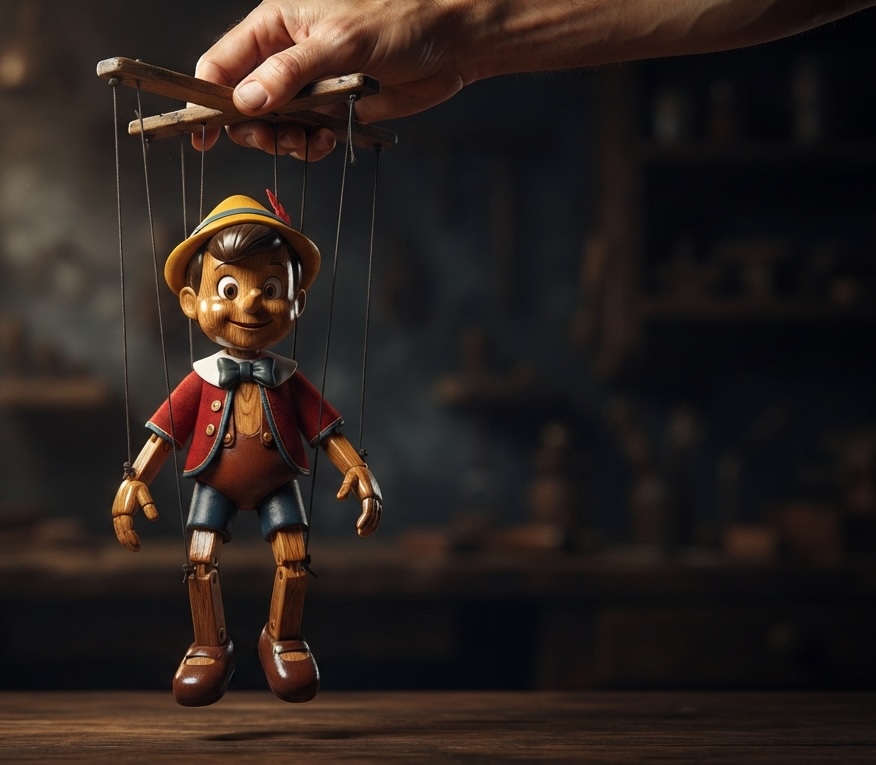
Welcome everyone come and join me on this journey of discovery as we take a metaphoric view of the story of Pinocchio, a novel written in 1881 by Carlo Collodi entitled The Adventures of Pinocchio. It tells the story of the little marionette who wants to be a real boy, and it is perhaps best known as the basis for the 1940 Disney film.
Pinocchio tells the story of a wooden puppet carved by a poor woodcarver named Geppetto who magically comes to life. Despite his father’s love and guidance, Pinocchio repeatedly ignores good advice, makes poor decisions, and falls victim to dishonest characters like the Fox and the Cat, leading him into a series of dangerous and often bizarre adventures. Along the way, he lies, causing his nose to grow, gets transformed into a donkey, and eventually finds himself swallowed by a giant whale, where he reunites with Geppetto. After rescuing his father and learning the importance of honesty, responsibility, and compassion, Pinocchio proves he has changed and is then rewarded by the Blue Fairy with his human transformation.
The story of Pinocchio teaches children valuable life lessons: disobedience often leads to trouble, dishonesty has consequences, and those who love, respect, and care for their parents are rewarded, the story continues to stand as a timeless literary classic.
What I offer to you is that on the surface this is a story for teaching children the aforementioned lessons, however as adults we can look at this classic tail as a metaphor for moving from being controlled by outside influences to taking ownership of personal choices and actions. As Pinocchio wanted to be free from the strings that Geppetto used to create (control) him; feeling that the strings confined and restricted his freedoms to become his true self. We too can seek to free ourselves from our strings of outside influences that unbeknownst and invisible are controlling our daily lives, affecting our thoughts and reactions. The key to our transformation is developing personal agency: not becoming immune to outside influences but learning to recognize them and consciously choosing how to respond.
In this enhanced interpretation, the pulling of our “strings” could represent whatever seems to make your choices for you:
- Other people’s approval: “I have to be who they want so they’ll accept me.”
- Inherited expectations: “This is the life I’m supposed to want.”
- Fear or guilt: “I can’t say no because disappointing someone would make me a bad person.”
- Unquestioned habits: “This is how I’ve always reacted.”
Since we have no idea how many strings connected Pinocchio as a marionette to the device Geppetto used to control him I will focus on the seven main domains or “strings” that we all deal with: career, health, relationships, finances, religion, social background, and personal habits as our universal puppet “strings.” There may be more that evolve as future “strings” in the theory, but these are the most impactful throughout this blog series.
For reflection, ask yourself:
- “What is pulling this “string”—fear, approval, habit, or something I truly value?”
- “Do I agree with the reason behind what I’m doing?”
- “What would a small, deliberate choice look like here?”
- “Can I own that choice without pretending I control everything?”
Not every limitation is within your control, and freedom does not mean having complete independence. Rather, the goal is to develop deeper awareness to act with purpose and intention.
Put simply, the journey is about shifting from “What is driving my actions?” to “What do I want to move toward, and what choices will get me there?”
As we embark on this journey together remember:
- Being without “strings” is different from being free.
- Freedom can include commitment.
- This is your journey of discovery, and you already hold the scissors to remove those unwanted “strings” that are holding you back in life.
To be Continued in Part 1: The Theory — From Puppet Strings to the Motivation Continuum
Sources:
https://www.britannica.com/topic/The-Adventures-of-Pinocchio
Written by Coach Martin edited By Victoria Burke
Discover more from Coach Colin Martin
Subscribe to get the latest posts sent to your email.